Spanish Prime Minister Declares National Mourning After High-Speed Train Collision Kills 68
The second fatal crash on Spain’s high-speed network this year occurred when a RENFE train struck a stopped IRYO service in Toledo province, killing at least 68 people and injuring 58.
By Olga Paredes ·
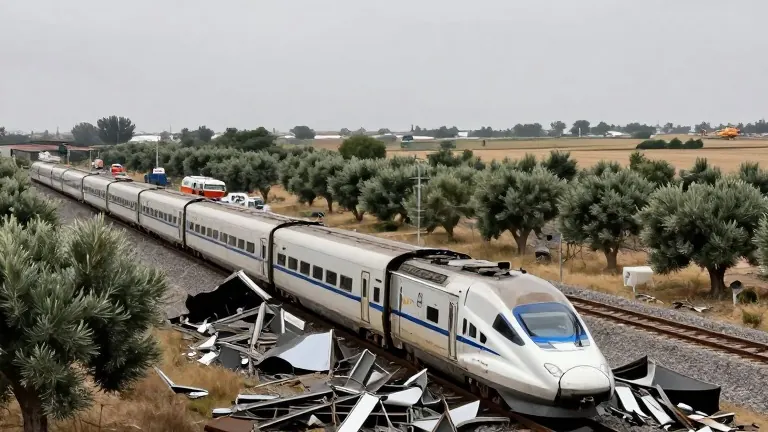
Spain’s Prime Minister Pedro Sánchez declared three days of national mourning on Wednesday following a high-speed train collision that killed at least 68 people. The regional government of Castilla La Mancha confirmed the death toll and reported that another 58 individuals were receiving medical treatment at hospitals. Rescue teams continued searching the wreckage throughout the day for survivors and bodies.
The crash occurred in the central province of Toledo, involving two trains traveling south from Madrid to Seville. Rail operator ADIF stated that a train operated by state-owned RENFE struck the rear of a stopped train operated by private company IRYO. The impact derailed two carriages at the tail of the IRYO train and the front section of the RENFE train.
Transport Minister Óscar Puente attributed the accident to an operational error by the central command center. He described the order to restart the RENFE train as “inexplicable.” Puente explained that a computer malfunction disabled the security system on a 63-kilometer stretch of track at 8:30 a.m., forcing all trains to halt. Despite an active stop signal, the command center authorized the RENFE train to resume movement without speed restrictions. The collision took place at 8:53 a.m. Puente noted the train may have been traveling at 200 kilometers per hour, the maximum speed for that section.
Passengers described the sudden force of the impact. Samy Paul, a British tourist rescued from the RENFE train, told the Associated Press, “Suddenly, everything started falling apart. Bang! We fell down.” He added that the first two carriages were smashed and blood was visible throughout. Ignacio Relaño, another RENFE passenger, said the train slowed abruptly before the impact caused the car to lean sharply. “Everything went flying, luggage, cell phones,” Relaño said.
David Gómez, a construction worker near the site, described cutting through fences to reach injured passengers. “As I was trying to pull a young woman out, there was a piece of a leg,” Gómez told the newspaper El País. Authorities deployed ambulances, medical helicopters, and a military emergency brigade to the scene, while buses transported uninjured survivors to safety.
This incident marks the second deadly high-speed rail crash in Spain within nine months. In January, an IRYO train derailed and collided with an oncoming RENFE train in southern Spain, killing 46 people. That January crash was the deadliest in the country since 2013, when 80 people died in a rail accident. Prior to 2026, Spain had not recorded a fatal crash on its dedicated high-speed lines since the network opened in 1992.
Sánchez visited the crash site in Urda, where he emphasized the need for increased safety measures to restore public confidence. “It is unacceptable for a country like Spain to suffer two high-speed rail accidents in the same year,” Sánchez said. He faces a national election on November 29. King Felipe VI also visited the site, and the monarchy issued a statement expressing grief for the families of the deceased.
Rail service was suspended between Madrid, Ciudad Real, and Andalusia. Spain’s soccer federation postponed all 24 Copa del Rey games scheduled for Wednesday. Spain has built 3,900 kilometers of high-speed track, a network that has recently opened to private competition. IRYO began operations in the country in 2022. Joan Rodríguez, a spokesperson for the train workers’ union, stated that increased traffic from privatization has strained infrastructure. “The increase in use of the network is a factor to keep in mind,” Rodríguez said.
European Commission President Ursula von der Leyen sent condolences, stating that Europe mourns with the victims’ families. The crash site was located in a flat area between the towns of Urda and Los Yébenes, surrounded by olive fields. Debris from the shredded carriages scattered across a gravel slope.
Source: Daily Breeze