36 Governor Races Define Midterm Stakes as Split Holds
Nineteen open seats and nine battlegrounds create a complex landscape where Democrats seek their first majority in two decades.
By Alejandro Brooks ·
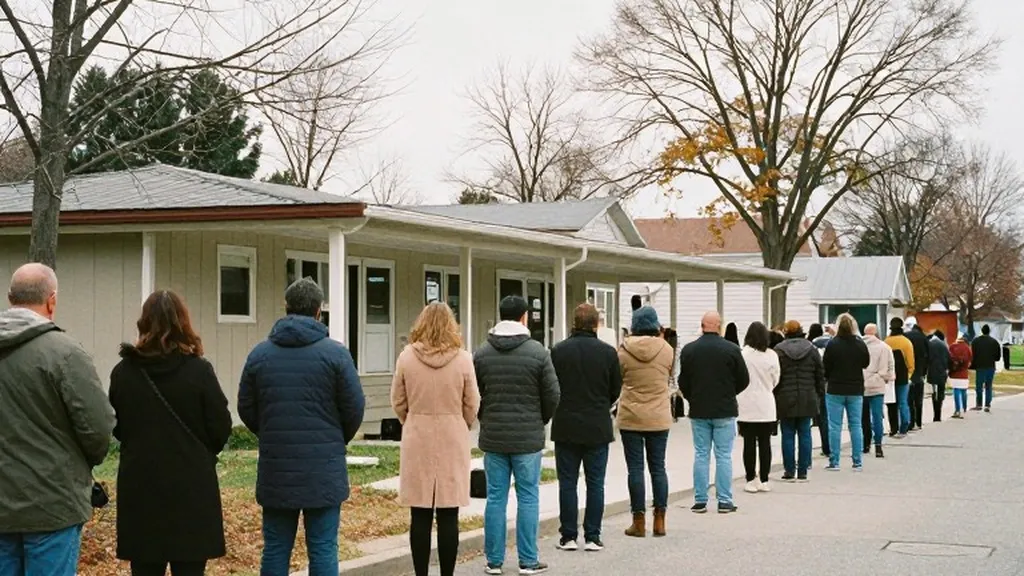
Voters across the United States are casting ballots for thirty-six governorships on Tuesday, a contest that will determine the balance of power in state executive offices. Heading into the day, the division of power is perfectly even, with Republicans holding eighteen of the offices on the ballot and Democrats holding the other eighteen. This numerical symmetry means that every single vote in these races carries significant weight for the overall control of state governments nationwide. The Associated Press notes that these races are part of a broader midterm election that decides who controls Congress for the remainder of President Donald Trump's second term.
The landscape of these thirty-six races is defined by a lack of incumbents in nearly half of the contests. According to Ballotpedia, nineteen of the governor races feature no incumbent on the ballot, a situation that creates uncertainty and opportunity for both parties. Fifteen of these open seats are due to term limits, meaning the sitting governors cannot run for a consecutive term. In three other cases, sitting governors chose not to run for various reasons. Kim Reynolds of Iowa, Tim Walz of Minnesota, and Tony Evers of Wisconsin all opted out of the race. A fourth open seat in Rhode Island resulted when Governor Daniel McKee lost his primary contest. These vacancies allow new faces to step onto the national stage and potentially shift the ideological balance of state leadership.
Nine specific governor races are identified as battlegrounds where the outcome remains uncertain. These states are Alaska, Arizona, Georgia, Iowa, Kansas, Michigan, Nevada, Ohio, and Wisconsin. In these jurisdictions, polls indicate that the candidates are within a margin that makes prediction difficult. The Associated Press highlights Texas, Florida, and Iowa as particularly competitive, noting that while Iowa is not on the primary battleground list for the governorship in some analyses, the race there is viewed as highly contested due to the political dynamics of the state. The outcome in these nine states will likely dictate whether one party achieves a nationwide majority or if the split remains intact.
Democrats are looking to secure a net gain of two governorships to claim a majority of state executive offices. This would mark a significant shift, as Republicans have held a majority of governorships since 2010. The Democratic Party is hoping to hold onto the five governorships they currently defend in states that voted for President Trump in 2024. These states include Arizona, Kansas, Michigan, Pennsylvania, and Wisconsin. Defending these seats is critical for the party's strategy to maintain a presence in traditionally Republican-leaning territories. The ability to retain these offices would signal strength in swing states that are pivotal for future elections.
Republicans, on the other hand, are focused on defending their eighteen governorships while also looking to expand their hold. Two of these offices are in states that voted for Kamala Harris in the 2024 presidential election: New Hampshire and Vermont. The Associated Press notes that Republican candidates in New Hampshire and Vermont are working to maintain their party's presence in these more Democratic-leaning regions. The party's strategy involves leveraging the national momentum of the president while also addressing local concerns. The outcome in these two states will be a key indicator of how well the Republican brand performs in areas where it does not have a strong historical base.
The race in Georgia is one of the most high-profile contests, featuring Republican healthcare executive Rick Jackson against Democratic former Atlanta Mayor Keisha Lance Bottoms. This race will determine who succeeds Brian Kemp, who is term-limited. The Associated Press reports that both candidates have campaigned heavily on economic issues, reflecting the broader national mood. In Nevada, Republican Governor Joe Lombardo faces Democratic Attorney General Aaron Ford. The AP notes that this race is competitive, with both candidates emphasizing their experience and policy positions. These two races are seen as bellwethers for the party's performance in the South and the West.
Another critical contest is in Ohio, where Republican Vivek Ramaswamy faces Democrat Amy Acton. The Associated Press reports that Ramaswamy's campaign faced backlash over an advertisement featuring Acton's estranged mother, a move that has generated significant media attention. This race is part of a broader fight for control of the Midwest, a region that has become increasingly competitive in recent elections. The outcome in Ohio will have implications for the national narrative, as the state is viewed as a crucial component of the electoral map. Both parties are pouring resources into this race, recognizing its importance for the midterm landscape.
The mood among voters is described by the Associated Press as one of struggle with high prices and anger over an unpopular war with Iran. This sentiment is driving turnout and shaping the issues that candidates are emphasizing. More than 57 million people had already voted as of Monday, surpassing the early vote totals from four years ago in many closely watched states. This high level of early voting suggests that the election will be closely contested, with the final outcome potentially hinging on last-minute turnout. The AP notes that Republicans are bracing to lose the House but are fighting to hold the Senate, while Democrats are cautiously optimistic about their chances in key races.
The financial aspect of the 2026 elections is also notable, with the Associated Press stating that this will likely be the most expensive election in history. Republican committees have out-raised and out-spent Democratic committees, aided by Trump-affiliated groups and support from Elon Musk. However, at the candidate level, Democrats have out-raised their opponents. This dynamic reflects the different strategies of the two parties, with Republicans focusing on national advertising and Democrats investing in targeted local campaigns. The amount of money spent on these governor races will influence the visibility of the candidates and the message that voters receive in the final days before the election.