Midterm Math: How Both Parties Tried to Break the Historical Pattern
With polls open, strategists on both sides deployed redistricting, massive spending, and targeted messaging to counter the historical trend of seat losses for a president's party.
By Olivia Barnes ·
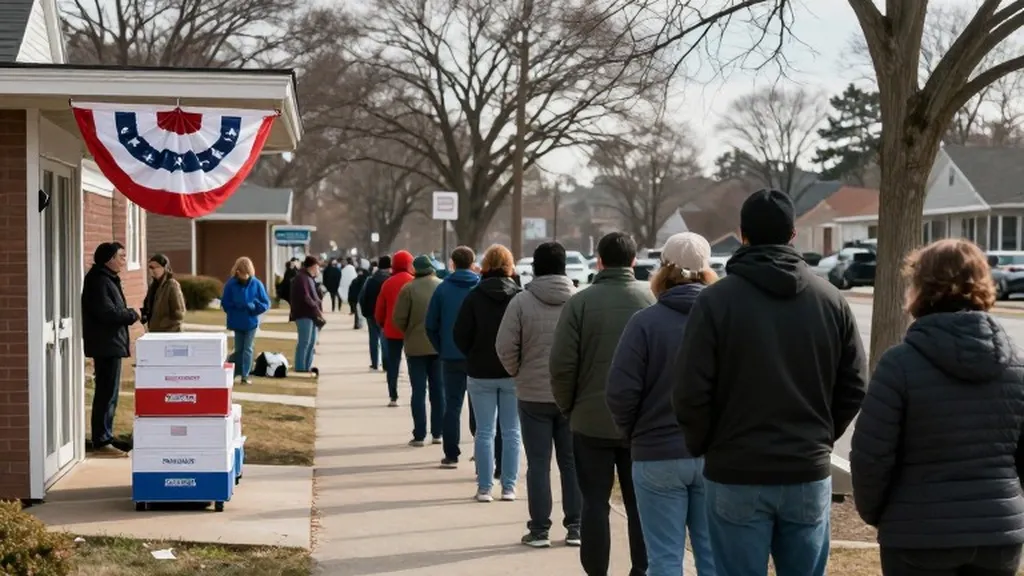
Historical trends in American politics suggest that the party holding the presidency almost always loses seats in midterm elections. This pattern has held firm for decades, creating a baseline expectation that the White House party faces a significant headwind. However, the 2026 midterm cycle has seen both Republicans and Democrats deploy aggressive strategies to defy this historical norm. As voters head to the polls today, the outcome will determine whether the president's party can maintain its footing or if the traditional mid-term penalty will take effect.
The Associated Press describes the election as a referendum on President Donald Trump's second term, with voters grappling with high prices and dissatisfaction over an unpopular war with Iran. According to AP-NORC polling, 35% of U.S. adults approve of the president's job performance, while about seven in ten say the country is heading in the wrong direction. These numbers set a challenging backdrop for Republicans, who are bracing for potential losses in the House while fighting to hold the Senate. Democrats, meanwhile, are described as cautiously optimistic, hoping to capitalize on economic frustration to gain control of at least one chamber of Congress.
Redistricting played a central role in the Republican strategy to beat the trend. Six states, including California, Florida, Missouri, North Carolina, Tennessee, and Texas, are using new congressional maps following mid-decade redistricting. Ohio also adopted a new map. Republicans argued that these new boundaries would create safer districts for their candidates, effectively insulating them from the volatility that often hits the president's party. However, the Associated Press notes that new districts in Florida and elsewhere may not vote exactly as drawn, adding a layer of uncertainty to the Republican calculus. The party also leaned on significant financial resources, with Republican committees outraising and outspending Democratic committees at the committee level, aided by Trump-affiliated groups and Elon Musk.
Democrats countered the historical trend by focusing on high-turnout strategies and economic messaging. DCCC Chair Rep. Suzan DelBene stated that the American people are angry and want change. The party relied on the fact that all 435 House seats are up for grabs, with Democrats needing a net gain of three districts to secure a majority. They targeted 21 Democratic-held districts that voted for Trump in 2024, aiming to consolidate support in those areas. At the candidate level, Democrats outraised their opponents, suggesting a different spending strategy than the party-level approach. The party hopes that high early voting, with more than 57 million people having already cast ballots, will provide a cushion against the typical mid-term erosion of support for the governing party.
The Senate race offers another battleground where both parties attempted to outmaneuver the historical pattern. Republicans hold 53 seats and can lose only two to maintain their majority. Democrats need a net gain of four seats. The Associated Press notes that one or two seats could tip the chamber. In key races such as Georgia, Ohio, and Michigan, candidates from both parties focused on local issues while also tying their campaigns to national economic conditions. In Georgia, Sen. Jon Ossoff faces Republican Rep. Mike Collins. In Ohio, former Sen. Sherrod Brown challenges Sen. Jon Husted. These races are critical because a loss of the Senate would give Republicans a unified government, while a Democratic victory would likely trigger investigations and possible impeachment proceedings.
Governorships also play a crucial role in the broader pattern. Republicans currently hold a majority of governor's offices, a position they have maintained since 2010. Democrats need a net gain of two governorships to achieve a nationwide majority. The Associated Press identifies races in Georgia, Nevada, and Ohio as particularly competitive. In Georgia, Republican health care executive Rick Jackson faces Democratic former Atlanta Mayor Keisha Lance Bottoms. In Nevada, Republican Gov. Joe Lombardo is running against Democratic Attorney General Aaron Ford. A Democratic victory in these states would mark a significant shift in the balance of power at the state level, further complicating the historical narrative of mid-term losses.
The role of the president in the campaign was a point of contention for both parties. Trump held dozens of rallies, ending his schedule in Salina, Kansas, where he urged voters to pretend he was on the ballot. However, many Republican candidates kept their distance from the president, a strategic move to mitigate the potential negative impact of his low approval ratings. Meanwhile, Trump continued to make claims about voting fraud and his administration filed lawsuits in Alaska and California, actions that Democrats fear could lead to interference and intimidation. The Justice Department's threat to prosecute local election officials added to the tension, with critics arguing that these moves risk disenfranchising eligible voters.
Voter sentiment reflects a mix of frustration and determination. Mark Barker of Palm Beach Gardens, Florida, told the Associated Press that he has been following Trump and thinks he is doing an awesome job. In contrast, James Moore, a librarian in Raleigh, North Carolina, noted that he is paying more taxes and more for healthcare. These individual stories encapsulate the broader economic anxiety that both parties are trying to address. The Republican argument is that the economy is improving and that stability is essential, while the Democratic argument is that the cost of living crisis demands a change in direction. Both sides believe their strategy can overcome the historical odds.
The financial aspect of the election is unprecedented. The 2026 elections are likely to be the most expensive in history. Analysis of AdImpact data by the Associated Press shows that 88.1% of Republican general election TV ad spending went to states and districts Trump won in 2024. This targeted spending suggests a strategy to lock in support in areas where the president is popular. Democrats, on the other hand, focused their resources on battleground districts and states where the race is close. This divergence in spending strategies highlights the different approaches each party is taking to beat the mid-term pattern.