Midterm Math: The Narrow Margin for Power Shifts
Democrats need four Senate wins and three House seats to take control, facing stiff odds in key races across the country.
By Alejandro Brooks ·
Forty-five Democratic senators hold their seats today, a number that leaves the party four victories short of seizing the majority in the upper chamber. Republicans currently occupy 53 of the 100 Senate seats. With two independents, Bernie Sanders and Angus King, who caucus with the Democrats, the effective split is 53 to 47. Vice President JD Vance holds the tie-breaking vote, meaning the Republican majority can absorb up to three losses before control flips to the opposition.
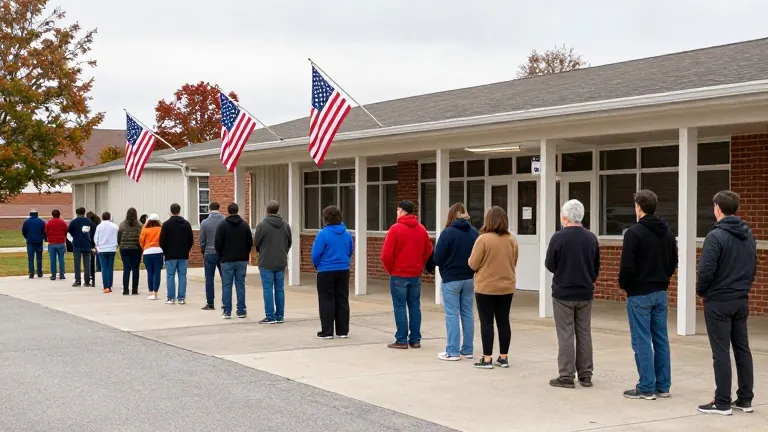
All 435 seats in the House of Representatives are up for grabs on Tuesday. The current balance is tight, with Republicans holding 220 seats and Democrats holding 215. Speaker Mike Johnson leads the Republican caucus in the 120th Congress. Democrats must capture at least three net seats to take over the House. This would mark the first time since the 117th Congress, which ended in 2023, that one party controls both chambers of Congress while the other party holds the presidency.
The most decisive battles for the Senate are taking place in five states: Michigan, Texas, Alaska, Ohio, and Kansas. In Michigan, former Representative Mike Rogers, a Republican, faces Abdul El-Sayed, a progressive Democrat. El-Sayed has faced attacks from pro-Israel groups over U.S. policy in the region. Days before the election, Haley Stevens, a Democrat who lost the primary to El-Sayed, endorsed Rogers. This move angered some party members while gaining support from Republicans.
Texas presents a different challenge for Democrats. The last time a Democrat won a Senate seat there was 1988. State Attorney General Ken Paxton is running against James Talarico, a former state representative. Paxton has focused his campaign on culture war issues, while Talarico has emphasized the economy and questioned Paxton's record regarding political scandals.
In Alaska, incumbent Republican Dan Sullivan competes against former Representative Mary Peltola. A different candidate with the same name, Mary Peltola, is running as an independent in the state's ranked-choice voting system. In Maine, moderate Republican Susan Collins faces Democrat Troy Jackson, a former state Senate president. Ohio features a rematch of sorts as incumbent John Husted runs against Sherrod Brown, who lost his re-election bid in 2024. ABC News rates the Ohio race as a toss-up. Kansas, a state President Donald Trump won by a large margin in 2024, sees incumbent Roger Marshall facing Adam Hamilton, a senior pastor.
Gubernatorial races offer historical firsts for several candidates. In Texas, Gina Hinojosa could become the first Latina governor if she wins. In New Mexico, Deb Haaland, the former Interior Secretary, would be the first Native American woman to serve as governor. Georgia's Keisha Lance Bottoms has the chance to become the state's first woman governor and the first Black woman to lead any state. In Ohio, Amy Acton faces Vivek Ramaswamy. Acton would be the first female governor of Ohio if she wins.
The Ohio race has drawn national attention due to a controversial attack ad. The ad features Acton's estranged mother calling her a liar. Acton, who has spoken publicly about childhood sexual abuse, said her mother supported the man who was charged with abusing her before he died in 2004. The ad prompted bipartisan criticism.
President Donald Trump has campaigned actively to protect the Republican hold on Congress. He announced a $5,000 cash payment for adult Americans, which he calls the Trump Dividend, if Republicans keep control of both chambers. Trump stated at a rally in Corpus Christi, Texas, that Republicans must win up and down the ballot to preserve recent policies. Former President Barack Obama also campaigned, appearing for Acton in Ohio. He told supporters that their frustration is best expressed by voting, not protesting.
Twenty-six women are major-party nominees for governor, a number that exceeds the 2022 record of 25. This includes 19 Democrats and seven Republicans. In the House, Democrats are aiming to elect at least 100 women, which would set a new record. Currently, 125 women serve in the House, split between 95 Democrats and 30 Republicans. Seven of the 14 toss-up House races feature Democratic women candidates.
Source: ABC7 Los Angeles