Israel's Knesset Left Without a Governing Majority After High-Turnout Vote
Neither Netanyahu's camp nor Eisenkot's opposition reached the 61 seats required, leaving 17 Arab-held seats as the decisive factor in forming a new government.
By Olivia Barnes ·
Neither the outgoing coalition led by Prime Minister Benjamin Netanyahu nor the opposition bloc headed by Gadi Eisenkot secured a governing majority in the Israeli election held Tuesday.
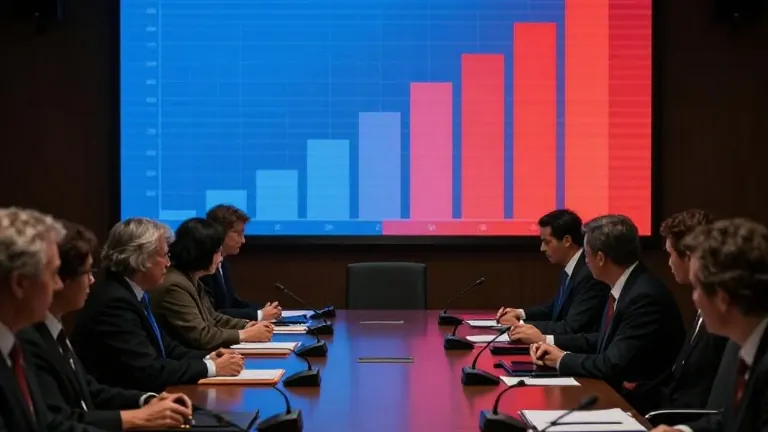
With nearly 80 percent of votes counted by Wednesday afternoon, the Likud-led coalition held 54 seats. The opposition, which includes parties ranging from the left-leaning Democrats to the hard-right Yisrael Beiteinu, had 49 seats. In the 120-seat Knesset, a party or alliance needs 61 seats to form a government.
The Arab-dominated Ra’am and Joint List held the balance of power with 17 seats. These numbers are provisional, with a final tally expected by Friday and official results published on November 4. President Isaac Herzog will now consult with party leaders before assigning a candidate to form a government. That candidate has 28 days to build a coalition, with a possible 14-day extension. If no coalition forms, the mandate may pass to another member, or the Knesset may be dissolved, sending voters back to the polls while the current cabinet serves as caretaker.
Turnout reached 77.7 percent, the highest since 1999. Among Palestinian citizens of Israel, who make up one-fifth of the population, turnout was approximately 80 percent. Analysts attributed this surge to harsher government treatment of the minority following the October 7, 2023 attacks and the subsequent war in Gaza. Roi Zur, a lecturer at Essex University, noted that two well-organized lists improved vote-collecting efficiency, particularly for the Islamist party Ra’am.
Critics described both major blocs as running polarizing campaigns. The Netanyahu camp made claims about opposition reliance on Arab parties and petitioned to bar the Joint List. On the other side, Avigdor Lieberman ruled out coalitions with Arab or ultra-Orthodox parties. Naftali Bennett, whose previous coalition included Ra’am, stated there was no mandate to form a government with Arab parties after the October 7 attack.
Former government adviser Daniel Levy identified four potential outcomes: a new election, Likud forming a government with defectors, a unity government led by Netanyahu, or Eisenkot forming a minority government with Arab support. Levy considered the last option unlikely but noted the Arab parties' demands would not be high. Mairav Zonszein of the Crisis Group said it would be difficult for Eisenkot to work with Netanyahu's camp due to disputes over the ultra-Orthodox draft and the October 7 security failures.
Zonszein noted that Bennett and Lieberman presented different possibilities for coalition building. Bennett previously broke election promises to work with Ra’am in 2021, while Lieberman’s hard-right stance could lead him to ally with Likud to block liberal politics. For now, the path forward depends on political negotiations or the potential for a new election if no coalition is formed within the allotted time.
Source: Al Jazeera