Washington voters choose five supreme court seats
Five of nine seats are up on Nov. 3, with the court facing pending cases on taxes and criminal law.
By Alejandro Brooks ·
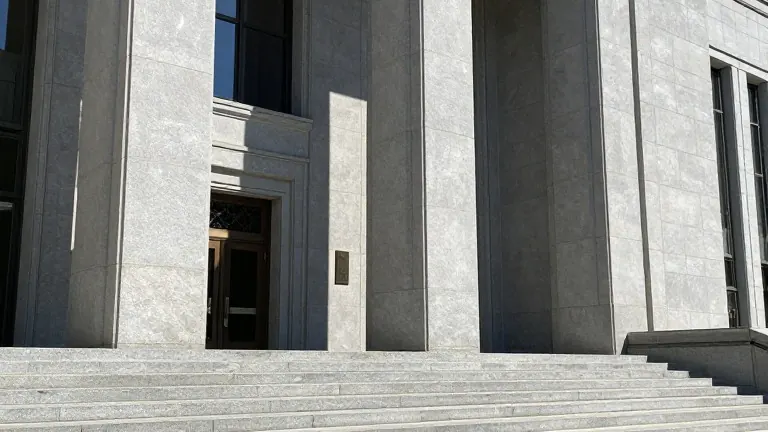
Voters in Washington state will select five of the nine members of the state Supreme Court on Nov. 3. The contest includes three sitting justices seeking re-election and two open seats. This election offers residents a direct method to influence the direction of the highest judicial body in the state.
The races are officially nonpartisan. However, the ten candidates hold varying judicial philosophies. These differences may shape how the court reviews laws passed by the Legislature and measures approved by the public. The upcoming terms will determine the court's approach to major questions in taxes, criminal justice, and education.
Todd Myers, vice president of research at the Washington Policy Center, stated that the court's rulings have a growing impact on daily life. "The court has become more activist in recent years, and so is making decisions that are much more impactful toward people's daily lives," Myers said. He noted that all ten candidates are qualified and possess good experience. The distinction lies in how they interpret the Constitution.
The specific races are as follows. Position 1 features Justice Colleen Melody against attorney Scott Edwards. Position 3 pits King County Superior Court Judge Jaime Michelle Hawk against Mason County Superior Court Judge David Stevens. In Position 4, Court of Appeals Judge Ian Birk faces King County Superior Court Judge Sean O'Donnell. Position 5 includes Justice Theo Angelis and former Federal Way Municipal Court Judge Dave Larson. Position 7 is a race between Chief Justice Debra Stephens and attorney Todd Bloom.
Positions 1 and 5 are special elections following gubernatorial appointments to fill vacancies. Position 4 is open following the retirement of Justice Charles Johnson. Myers observed that roughly 20% of voters skip these races. He argued that voting in these contests carries extra weight because it represents the choices of those who abstain.
A key example of the court's influence is Initiative 2066. Voters approved this measure by 51.7% in November 2024. The initiative aimed to protect access to natural gas and limit local policies discouraging its use. In September 2026, the Supreme Court ruled 6-3 that the initiative was unconstitutional. The court found the measure violated the state constitution's single-subject requirement by combining distinct subjects.
Myers described this ruling as part of a pattern where the court overturns voter-approved measures. "The will of the voters should be honored, and the court has gotten a reputation for overturning the will of the voters too easily on too many technicalities," he said. The decision was based on the court's interpretation of constitutional requirements for legislation.
The court may also decide the fate of Washington's new income tax. The Legislature approved a 9.9% tax on annual income above $1 million in 2026. The tax is set to take effect on Jan. 1, 2028, with the first returns due in 2029. This law could face constitutional challenges. The justices elected in November may determine if the tax survives if the case reaches the Supreme Court.
Six of the nine current members joined the court through gubernatorial appointments. Governor Bob Ferguson appointed Justice Colleen Melody in November 2025 to replace retiring Justice Mary Yu. She assumed her position at the beginning of 2026. Myers said this number of appointments has contributed to a politically divided court. He suggested voters can choose between a partisan court or a more balanced one.
The court also handles cases involving criminal law and public education. Its 2021 ruling in State v. Blake declared the state's strict-liability drug possession statute unconstitutional. That decision led lawmakers to revise state law. The court is currently weighing issues such as the shortage of public defenders and whether lawmakers are meeting their duty to fully fund public schools. Myers encouraged voters to research candidates' judicial philosophies and legal records before casting their ballots.
Source: KZJO